Load-Based Sizing
Capacity and power are matched to the circuits, surge demand and backup duration that matter to your property.
For Abu Dhabi properties, battery planning should consider ADDC/AADC treatment alongside backup circuits, evening use and any existing solar. SolarPanelUAE connects eligible requests with an installer partner for that review.
⏱️ Share the basics about your property · No obligation
Capacity and power are matched to the circuits, surge demand and backup duration that matter to your property.
Battery, inverter, solar and grid operation are designed as one coordinated system.
The proposal covers isolation, protection, ventilation, equipment placement and applicable approvals.
Track state of charge, solar production, grid use and backup availability from one system.
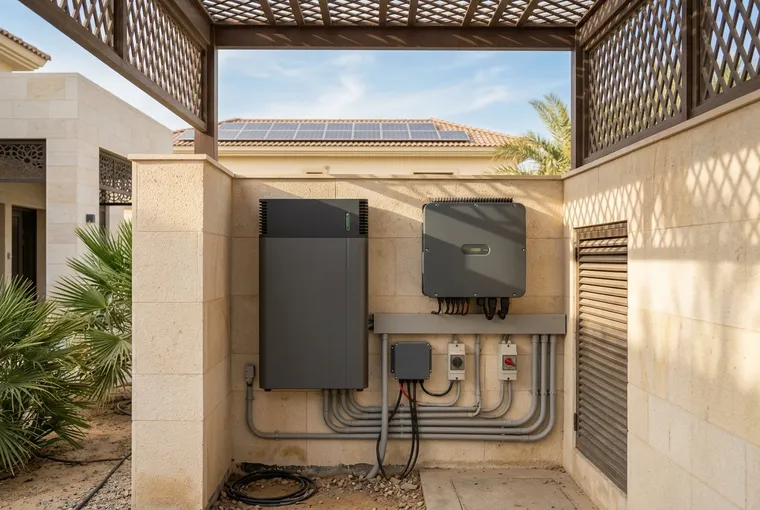
Abu Dhabi is the emirate where storage has been written into the policy framework rather than left to sit alongside it, and that shifts the conversation from whether a battery is permitted to what it is actually for. The Department of Energy’s Solar Energy Self-Supply Policy, launched in February 2026 for farms, rest houses and ranches and opened to villa owners in a second phase, includes battery storage within its scope.
Two distribution companies operate here — ADDC across Abu Dhabi city, AADC across the Al Ain region — and the older Small-Scale Solar PV Energy Netting Regulation allows systems up to 5 MW per premises with surplus settled as a kilowatt-hour offset rather than as cash. That last detail is the one that matters for a battery. If a surplus unit is offset against consumption, then storing it and using it later is not automatically worth more than exporting it, and the storage case cannot rest on arbitrage alone. The value has to come from continuity of supply, from shifting when the site draws from the grid, or from a difference between the offset treatment and the value of consumption avoided — and that difference is worth confirming with the installer or the Department of Energy rather than assuming.
Likely to help: a property with loads that cannot tolerate an interruption, a requirement to hold specific circuits live, or a short daily window of heavy draw. Less likely: a site adding storage purely to capture more value from surplus, where the offset arrangement may make the exercise close to neutral after conversion losses. Regulation and Supervision Bureau approval is needed before the connection application goes in, so the battery should be part of the design from the start rather than an addition once the solar is approved.
Is storage being proposed under the self-supply policy or the netting regulation, and what changes depending on which applies? Which circuits are backed up and for how long at the load the property actually draws? What is the usable capacity as distinct from the nameplate figure, and how does the system behave at the moment supply drops? Does the Regulation and Supervision Bureau submission treat the battery separately? How is the warranty framed — years, cycles or throughput — and who is responsible for monitoring? Insist on written answers to each one.
See the full checklist before you request an assessment.
Last reviewed: 26 September 2026.
Battery storage is part of the Department of Energy's Solar Energy Self-Supply Policy framework. How that interacts with a connection made under the older Small-Scale Solar PV Energy Netting Regulation should be confirmed with the installer partner or directly with the Department of Energy.
Regulation and Supervision Bureau approval is required before the connection application is submitted. Ask the matched partner where the battery sits in that approval, and whether storage is assessed as part of the same application or separately.
ADDC serves Abu Dhabi city and AADC serves the Al Ain region, so the distribution company depends on where the property sits. Ask the partner to confirm which one the application goes to and whether their storage requirements differ.
It may, because surplus is settled as a kilowatt-hour offset rather than a cash payment, which makes storing a unit and consuming it later closer to neutral than many proposals assume. Ask the partner to state the difference explicitly.
Usable capacity as distinct from nameplate, the circuits covered, duration at your measured load, warranty in years and cycles, monitoring arrangements, and who is responsible when something faults.
Tell us about your property and we will route your request to a suitable installer partner.