Data-Led Design
System size is modelled against operating hours, interval demand and usable roof area.
SolarPanelUAE is an independent lead-generation platform. We connect Dubai businesses with installer partners for commercial solar assessment, utility coordination and proposal review.
🏭 Warehouses & factories · CAPEX or PPA · No obligation
System size is modelled against operating hours, interval demand and usable roof area.
Structural limits, safe access, cable routes and delivery phases are addressed before installation.
The proposal identifies utility submissions, property documents, inspections and connection milestones.
Output, self-consumption and commercial assumptions are presented clearly for like-for-like review.
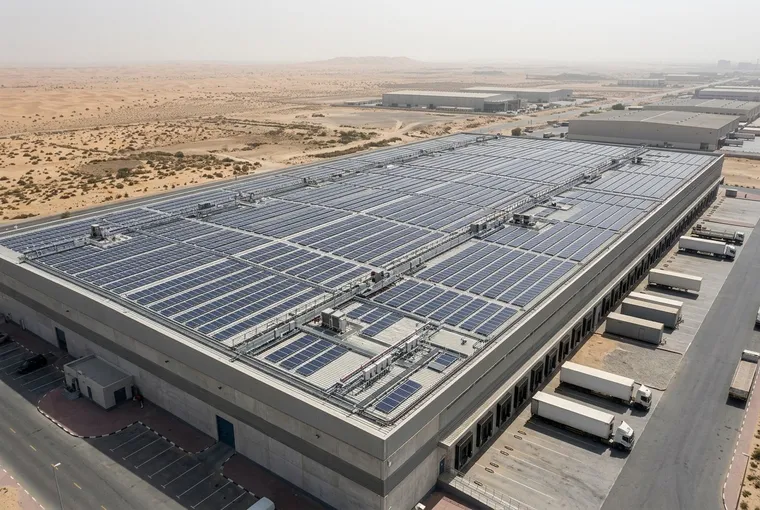
Dubai operates the most established commercial rooftop-solar route in the country, and that shapes what a credible proposal looks like. Instead of valuing exports against a separate tariff, the emirate settles them against the site’s own consumption slab, which puts the building’s daytime demand at the centre of the design. For a business, the useful questions are therefore about the load profile and the roof, in that order.
Enquiries most often reach us from units in Jebel Ali Free Zone (JAFZA), Dubai Investment Park and Al Quoz Industrial Area. Those names are best read as local context rather than as a verdict: a zone says nothing on its own about roof condition, structural headroom, shading cast by neighbouring sheds, or whether the site’s load actually runs while the sun is up.
DEWA administers Shams Dubai. Exported units are credited at the property’s own consumption slab rate, so two similarly sized warehouses can see different credit values depending on the tariff band each one sits in. Any credit the site does not use carries forward instead of lapsing at the end of a period. Systems are accepted up to 1 MW on a single plot, which is a real constraint for a large distribution roof that could physically hold far more panels. Submission runs through DEWA’s Hab Reeh platform, and both the installer and the equipment have to satisfy DEWA’s current listing requirements before an application will move forward.
Because unused credit survives the billing period, a Dubai array does not have to be clipped to whatever the building absorbs on the day. The partner should still work from interval consumption, shift patterns and usable roof area, because self-consumed and exported units are worth different amounts once the slab rate is applied. Whether the project is purchased outright or funded through a PPA also changes what the design is optimised for, so settle the funding route before the capacity is fixed.
A commercial survey also asks for things a villa assessment does not. The partner will want electricity data at a granularity that shows when the site draws power rather than only how much, together with operating hours and any planned additions to the load such as extra chilling capacity or vehicle charging. Roof construction, usable area once setbacks are allowed for, and safe access for cleaning and maintenance all constrain the layout before any capacity figure means much, and lease or ownership documents form part of the proposal.
See the full checklist before you request an assessment.
Last reviewed: 26 September 2026.
The DEWA submission runs through the same Hab Reeh platform regardless of whether the unit is in JAFZA, Dubai Investment Park or Al Quoz. Ask the matched partner to confirm any additional free zone authority requirements that apply to the specific unit before work is scheduled.
Unused credit carries forward rather than lapsing, and the rate it is credited at follows the property's own consumption slab. Ask the partner to model both the self-consumed and exported portions rather than assuming a single value for every exported unit.
Shams Dubai accepts systems up to 1 MW per plot, so a large logistics roof can run out of connection headroom before it runs out of space. Ask the partner to confirm the plot's ceiling before a capacity is proposed.
Both the installer and the equipment have to satisfy DEWA's current listing requirements. Ask the partner to name the panel, inverter and mounting makes and models in the proposal rather than describing them generically.
Yes, and it is the sensible order. Roof condition, structural capacity, usable area and the site's consumption pattern are what determine a workable capacity, and none of them can be established from a satellite image.
Tell us about your property and we will route your request to a suitable installer partner.