Load-Based Sizing
Capacity and power are matched to the circuits, surge demand and backup duration that matter to your property.
For Fujairah properties, an installer partner can weigh EtihadWE export-credit treatment against backup and evening-use goals. SolarPanelUAE connects eligible requests for a property-specific battery review.
⏱️ Share the basics about your property · No obligation
Capacity and power are matched to the circuits, surge demand and backup duration that matter to your property.
Battery, inverter, solar and grid operation are designed as one coordinated system.
The proposal covers isolation, protection, ventilation, equipment placement and applicable approvals.
Track state of charge, solar production, grid use and backup availability from one system.
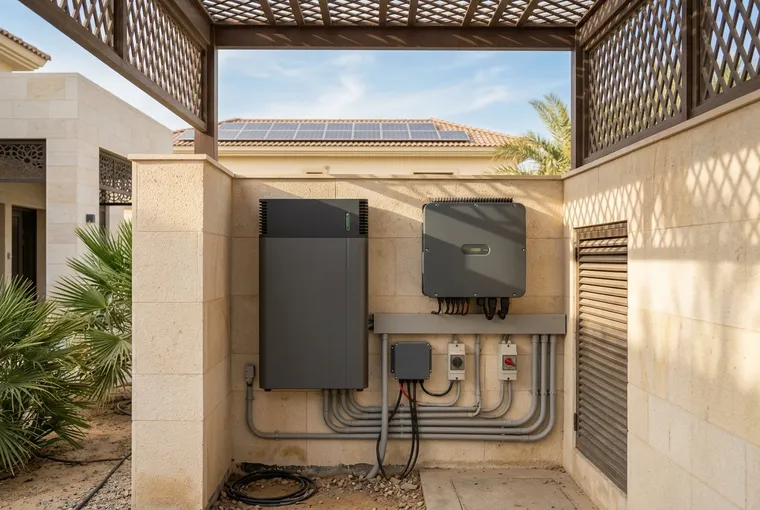
Fujairah’s connection terms are set by EtihadWE’s Distributed Solar System, and one clause in that scheme does most of the work in any storage conversation: credit accumulated from exports is cleared when the calendar year ends. The clause is real, and it is also more limited than it sounds.
Read alongside the monthly meter comparison, the reset has a narrower reach than the summary suggests. EtihadWE compares imports and exports every month, which lets a surplus in one period absorb a shortfall in another. Only a property that finishes the year having exported more than it consumed forfeits anything at all. Sites running refrigeration, process plant or shift work rarely land in that position, because their daytime load takes most of what the array makes. The properties that might are those with a large array over a modest load, or an operation that idles while the panels keep producing.
Continuity is the argument that stands whatever the credit position turns out to be. Where a site runs cold storage, process equipment or anything with a cost attached to stopping, a battery converts an interruption from an event into a non-event. Where the load is ordinary and the annual balance is negative, the battery is being asked to fix something that was never broken, and a proposal should be able to state plainly what it delivers instead. If the only answer offered is protecting credit, check the annual balance before accepting it.
Has the partner calculated the annual import-export position, or only a representative month? How does storage appear in the EtihadWE submission, and does the Fujairah Municipality NOC extend to it? Which circuits stay live, for how long at the load the property actually draws, and does the changeover happen without anyone acting? What is the usable capacity rather than the nameplate figure, how is the warranty framed in years and cycles, and who monitors the installation? Every answer in writing, before the proposals are compared.
See the full checklist before you request an assessment.
Last reviewed: 26 September 2026.
Not necessarily. Continuous daytime load usually means most of the generation is consumed on site, which is exactly the situation where a battery adds least. Ask the partner to show what share of output is already self-consumed before a capacity is proposed.
Only for properties that close the year having exported more than they imported. Because EtihadWE compares the meters monthly, most sites absorb their exports within the year. Ask the partner for the annual balance rather than assuming the reset applies to you.
A municipality NOC forms part of the EtihadWE process, but we have no verified detail on how storage is handled within it. Ask the matched partner to confirm whether the same NOC covers the battery or a separate one is required.
EtihadWE has no mature self-service portal on the Dubai model, so the installer partner lodges it. Ask whether storage is covered by the same submission as the solar or requires its own.
Usable rather than nameplate capacity, the circuits it holds up, the duration at the load you actually draw, how it behaves when supply drops, warranty in years and cycles, and who monitors it.
Tell us about your property and we will route your request to a suitable installer partner.